

Missing a tooth can feel like a small inconvenience until you start looking into dental implants and hear a term you were not expecting: bone graft. For many patients, this extra step raises immediate questions about why it is needed, how long it adds to treatment, and whether it applies to their specific situation. The honest answer is that not everyone needs one, but a surprising number of people do, often for reasons they never would have guessed on their own.
At Floss Lincoln Park, we walk patients through this decision using imaging and a physical exam rather than guesswork, so you know exactly where you stand before committing to dental implant treatment. Understanding the warning signs ahead of time can help you approach your consultation with realistic expectations and fewer surprises along the way.
Why Jawbone Health Matters for Implants
A dental implant is not just a replacement tooth sitting on top of your gum. It is a small titanium post that gets placed directly into your jawbone, where it needs to fuse solidly with the surrounding bone tissue to function properly. If that bone is too thin, too short, or too soft, the implant has nothing stable to hold onto, which raises the risk of the implant shifting, loosening, or failing outright.
This is why your dentist evaluates bone volume and density before ever discussing implant placement. Once a tooth is gone, the jawbone in that area loses the stimulation it once received from chewing, and it can begin to shrink over time. Research on bone remodeling after tooth extraction shows that this resorption process can begin fairly quickly, which is part of why the timeline of your tooth loss matters so much to your treatment plan.
Signs You May Need Bone Grafting Before Getting Dental Implants
Several patterns tend to show up in patients who end up needing a bone graft before their implant. None of these guarantee that grafting is necessary, but they are common enough that your dentist will look for them specifically during your exam and imaging review.
Consider the following situations that often point toward the need for grafting:
- Long-term tooth loss: A gap that has been open for a year or more often shows noticeably more bone shrinkage than a recent extraction site.
- History of gum disease: Periodontal disease can erode the bone that supports your teeth, leaving less structure behind for an implant.
- Denture wear: Years of wearing a removable denture can accelerate bone loss in the jaw beneath it.
- Visible jaw changes: A sunken or flattened appearance where a tooth used to be can be a visible clue of reduced bone volume.
- Prior trauma or infection: An injury or untreated infection near the tooth root can leave gaps or weakened areas in the bone.
If any of these apply to you, it does not mean an implant is off the table, only that a grafting conversation is likely to come up early in your treatment planning.
How We Determine If You Need Bone Grafting
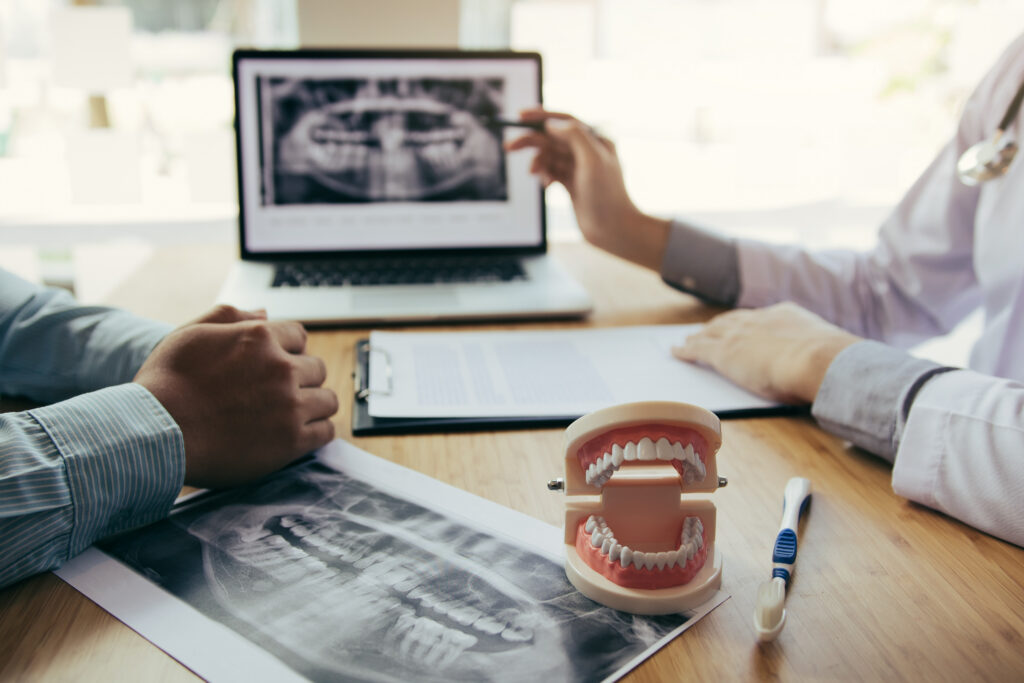
Guesswork has no place in implant planning, which is why imaging plays such a central role in the process. X-rays and 3D scans allow us to measure the exact height, width, and density of the bone in the area being considered for an implant, giving a much clearer picture than a visual exam alone could provide.
What The Imaging Actually Shows
These scans reveal whether there is enough bone to anchor an implant securely for the long term, or whether the area falls short of what is needed. They can also identify nearby structures, such as nerves or sinus cavities, that may affect where and how an implant can be placed.
From there, we can walk you through what grafting would involve in your specific case, since the approach can vary depending on how much bone needs to be rebuilt and where the shortfall is located.
What To Expect If Grafting Is Recommended
Bone grafting typically involves placing material at the site to encourage your body to generate new, healthy bone over the following months. Once that new bone has matured and integrated with the surrounding structure, the area is generally ready for implant placement. It adds time to the overall process, but it also gives the implant a much stronger foundation to rely on.
Get Personalized Answers About Bone Grafting at Floss Lincoln Park
Every patient’s jaw tells a different story, shaped by how long a tooth has been missing, whether gum disease has been part of the picture, and how the bone has responded over time. Rather than applying a one-size-fits-all answer, our team reviews your imaging and history together so any recommendation for bone grafting is based on what your jaw actually needs.
Dr. Martha Silva brings a particularly detailed lens to these evaluations, having served as an active duty dentist with the U.S. Army before continuing her education through an advanced two-year program with the University of Florida School of Dentistry, which will earn her a Mastership with the Academy of General Dentistry after more than 600 hours of additional training. Reach out to us to schedule a consultation and get clear, personalized answers about your next steps.


