


Your dentist recommends a “deep cleaning,” and suddenly the appointment feels more serious than a routine visit, but what does that actually mean, and why can’t a regular cleaning do the same job? The answer lies in what’s happening beneath your gum line, and understanding the difference could change how you think about your long-term oral health.
At Floss Lincoln Park, we believe every patient deserves to understand exactly what’s happening in their mouth and why. Our team, led by Dr. Delone Jouja and Dr. Martha Silva, provides both routine preventive care and advanced periodontal treatments at our Lincoln Park office. If your provider has mentioned scaling and root planing, you may be wondering how it differs from your twice-yearly cleaning and whether it’s truly necessary.
What Happens During a Regular Dental Cleaning?
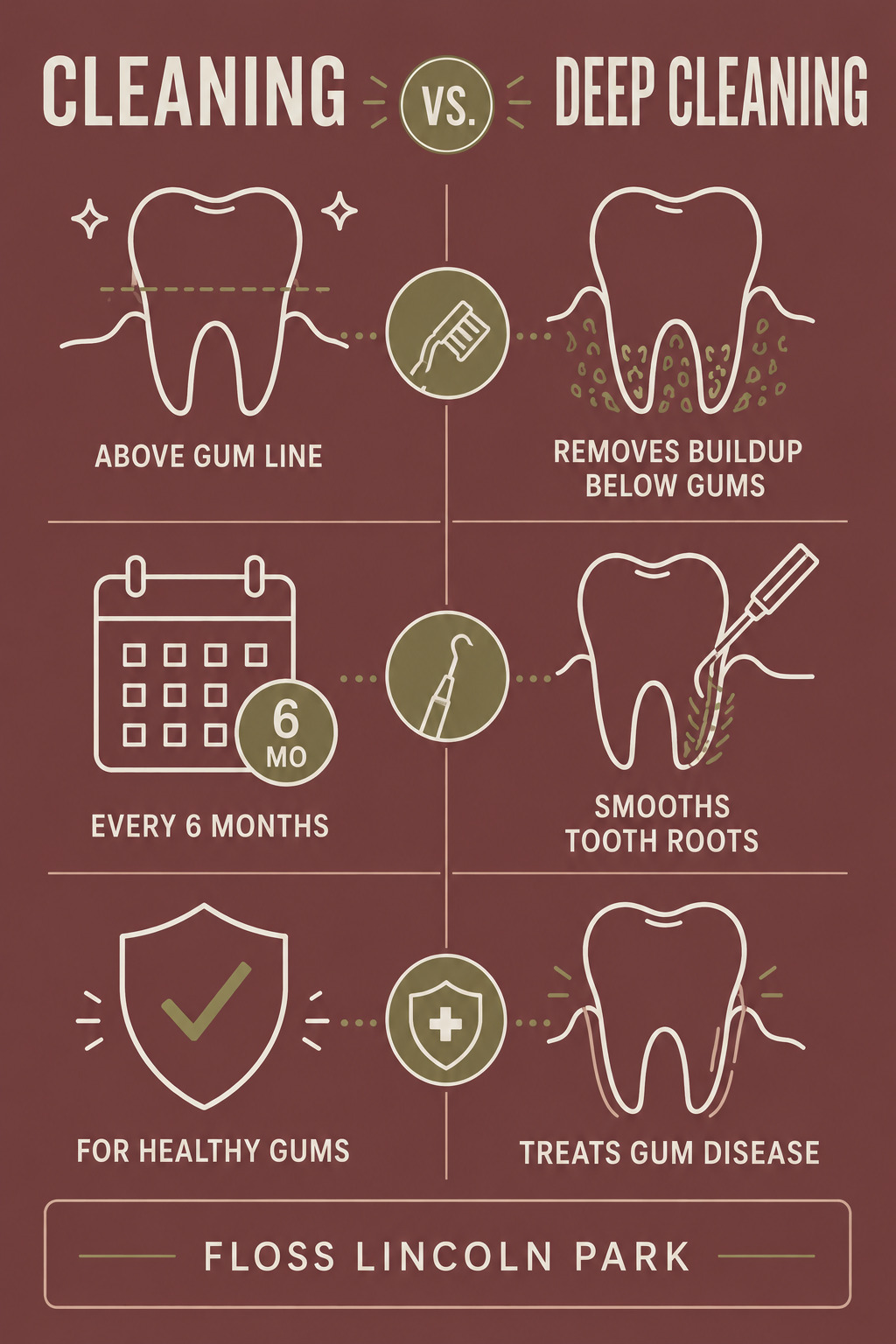
A standard dental cleaning is a preventive procedure designed to maintain the health of teeth and gums that are already in good condition. During this appointment, a dental hygienist removes plaque and tartar from the surfaces of your teeth, polishes the enamel, and checks the health of your gum tissue. The process takes place above the gum line and, in shallow pockets around the teeth, just slightly below it.
Regular cleanings are typically recommended every six months and are part of your dental exams and cleaning routine. They are not designed to treat active gum disease. If a standard cleaning is compared to routine maintenance, think of it as keeping a healthy home tidy. It works perfectly well when the foundation is sound.
What Scaling and Root Planing Involves
Scaling and root planing is a non-surgical periodontal treatment that goes significantly deeper than a routine cleaning. It is designed specifically for patients who have signs of gum disease, including deeper-than-normal pockets between the teeth and gums, where bacteria, plaque, and tartar have accumulated below the gum line.
The procedure has two distinct components. Understanding each one clarifies why this treatment requires more time, more clinical skill, and sometimes a local anesthetic:
- Scaling: Your provider removes plaque and hardened tartar (calculus) from below the gum line, reaching into the periodontal pockets that have formed as the gums pull away from the teeth.
- Root planing: The surfaces of the tooth roots are smoothed down to eliminate rough areas where bacteria tend to collect and to encourage the gum tissue to reattach securely to the tooth.
The American Academy of Periodontology notes that many patients do not require additional periodontal treatment after scaling and root planing, though most will need ongoing maintenance to preserve their results.
Why One Cannot Substitute for the Other
A regular cleaning, scaling, and root planing are not interchangeable, and attempting to treat gum disease with only a standard cleaning would be insufficient. Gum disease, or periodontitis, develops when bacterial infections take hold below the gum line in areas that routine brushing, flossing, and standard cleanings cannot reach. At that stage, professional intervention is required to disrupt the bacterial environment and allow the tissue to heal.
How Pocket Depth Guides the Decision
Dentists measure the space between your teeth and gums, called the pocket depth, using a small probe during your exam. Healthy pockets are typically 1 to 3 millimeters deep. When pockets reach 4 millimeters or more, particularly with signs of bleeding or infection, scaling and root planing is generally recommended. This measurement is one of the key reasons regular checkups matter: catching elevated pocket depths early lets us start treatment before gum disease progresses further.
What to Expect After the Procedure
Most patients experience some sensitivity and mild soreness for a few days following treatment, particularly in the treated areas. Your provider may recommend a follow-up visit to evaluate how the gum tissue has responded and whether any additional care is needed. Good dental hygiene at home, including gentle but thorough brushing, daily flossing, and any additional tools your provider recommends, plays a critical role in how well you heal and how long your results last.
Schedule Periodontal Care at Floss Lincoln Park
Understanding the difference between a regular cleaning and scaling and root planing is the first step toward making confident decisions about your oral health. Both procedures play important roles, and the right choice depends entirely on what your gums need.
At Floss Lincoln Park, Dr. Jouja and Dr. Martha Silva bring a combined 24 years of clinical experience to every patient visit. Dr. Silva’s advanced training through the University of Florida School of Dentistry’s Mastership program, representing more than 600 hours of continuing education, informs the periodontal and preventive care we provide. We accept most major insurance plans and offer an in-house membership plan for patients without coverage. To ask questions or schedule your appointment, contact our office today.


